
President Muizzu Warns Even Small Loss of Maldivian Territory Threatens National Independence
13 November 2026 - 07:03
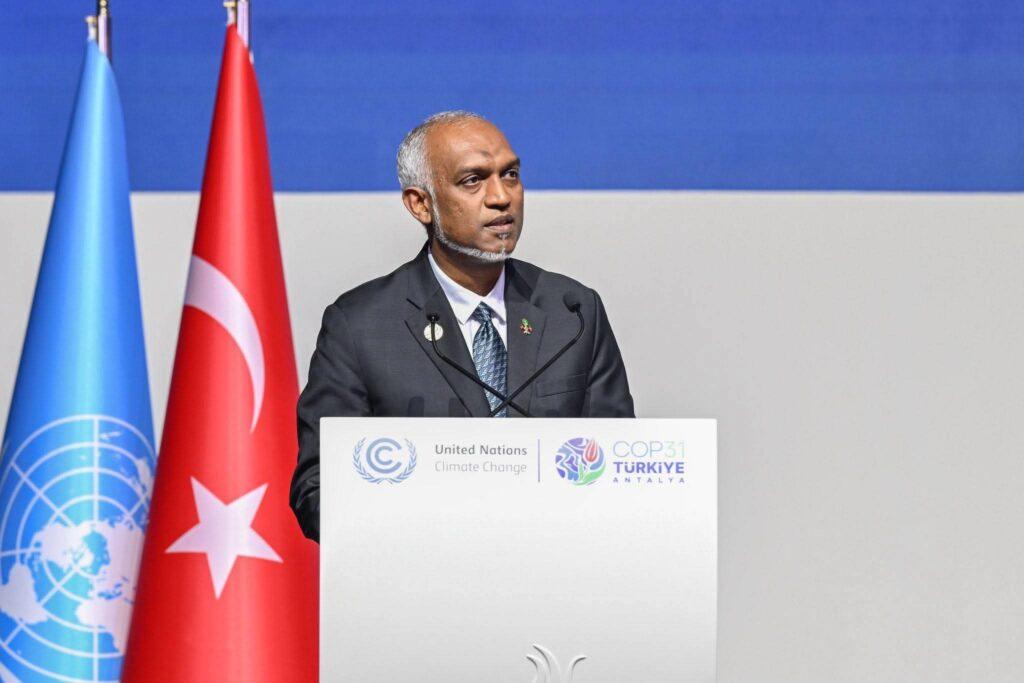
President Dr Mohamed Muizzu has warned that even the loss of a small portion of Maldivian territory poses a threat to the country’s independence, heritage and future.
The President made the remarks while speaking at a session titled ‘Sea-Level Rise: Multi-Level Action for Coastal Resilience’, organised by the United Nations Global Centre for Climate Mobility (GCCM) in Türkiye.
Addressing the session, President Muizzu described rising sea levels as more than a temporary obstacle to development, warning that they pose a serious threat to the long-term survival of the Maldives. He emphasised that the country’s islands are not merely pieces of land, but represent the homes, history and identity of the Maldivian people.
He stressed that protecting the right of Maldivians to continue living on their own islands is a matter of national priority, noting that even a small loss of territory could have lasting consequences for the country’s sovereignty and future.
Highlighting national efforts to strengthen climate resilience, the President said the Government is working to protect natural island barriers, preserve lagoons and safeguard coastlines. He also underscored the importance of ensuring that communities have access to the information and financial resources needed to implement climate adaptation measures at island level.
President Muizzu cited Hulhumalé as an example of investment in climate resilience, describing the elevated and reclaimed island as an important measure to strengthen the Maldives’ protection against climate-related risks.
He also highlighted the development of Rasmalé as a low-carbon eco-city powered by renewable energy, noting that the island is being developed at an elevation above projected sea-level rise.
The President said these initiatives reflect the Government’s vision of integrating climate resilience into national development, as the Maldives works towards achieving developed-country status by 2040.
He called on the international community to incorporate climate mobility into adaptation planning and provide adequate, sustainable and accessible financial support to vulnerable countries. He stressed that such assistance should be provided as grants rather than charity, describing it as a matter of climate justice.
Concluding his remarks, President Muizzu reaffirmed the Government’s commitment to protecting the country’s islands so that future generations can continue to live, build their lives and prosper on the land inherited from their ancestors.